Back at the International Festival

The Bath International Music Festival, after nearly being subsumed entirely in the Literature Festival (I didn’t go to any of the handful of concerts in it last year as it clashed with my Romanian choir tour) now no longer runs concurrently with it and there was a satisfactory selection of concerts.

Others in the family went to a couple of piano recitals: firstly, Richard Goode playing Beethoven’s last three Sonatas (and op. 119 Bagatelles) in St Mary’s Bathwick. Goode is an undemonstrative pianist and his interpretations of his chosen repertoire have been refined over the years; with him, you know what you are getting. Later, Ethan Loch in St Swithin’s Church played some of his own compositions amongst other things including Liszt’s sonata and Chopin’s third Scherzo. It seemed that he had carefully chosen repertoire that suited him, though without much dynamic variation, even in the Liszt! The Chopin seemed to suit him best; his own compositions were not especially interesting.

I went to the last concert of all (thereby getting a free Festival programme), Brecon Baroque also in St Swithin’s Church. This was ‘The Muses Restor’d’: sequences of pieces from the English 17th and early 18th century, many by composers I hadn’t previously encountered, although Purcell, Blow and Handel also featured. Some had drawn on folk music (chiefly Scottish) for their inspiration, and much of it was suitable for dancing, which brought it close to the folk fiddle repertoire I heard a few years ago. As you would expect, there was a handsome array of instruments including an archlute (or was it a theorbo? I’m never quite sure how to distinguish them.)

Soon after the Festival ended we received our Mozartfest 2026 brochures. For a time the Mozartfest overtook the International Music Festival for its calibre of performers; I’d say they are currently about level.
Posted in going to concerts | Tagged , , , , , , , , , , | Leave a comment

I never want to sing The Spirit of the Lord again

A few years ago Elgar’s The Spirit of the Lord was the anthem at a forthcoming service I was due to sing in. In the run up to this we had several different conductors taking rehearsals and this anthem was dutifully rehearsed each week, even though there was other music we were less familiar with that needed attention. Generally, I feel I’ve been over-exposed to it over the years and so now I have a definite aversion to it, unless in its original context as the opening of The Apostles.

Unfortunately I found myself singing it twice in one weekend, this being an occupational hazard of Pentecost (this feast is not as badly off as Easter, but is not well endowed with anthems). The first was a special evensong at Gloucester Cathedral, originally intended to celebrate the completion of work on the organ, and sung by members of Gloucester Choral Society, mostly those who weren’t also singing in the Three Choirs Festival chorus.

The piece which took most learning was Donald Hunt’s setting of the Responses – not the ones cobbled together from bits of Wesley in E and other pieces by S S Wesley, but some he’d written himself more or less in the style of Sumsion. Normally Responses take up little time in rehearsal (with some exceptions such as Howells’) but these, although not hard for the most part, were quite florid with a lot of notes which had to be learnt. In the end we didn’t sing the Lord’s Prayer. I hadn’t come across them before; maybe they are only in the repertoire at Worcester?

The Worcester connexion was maintained with Blair in B minor canticles. Our introit was another Pentecost standard, Tallis’ If ye love me. Unfortunately the Cathedral organ wasn’t ready yet so we were still accompanied on the toaster which didn’t really do justice to the Blair or the Elgar.

On Sunday at Bath Abbey more Tallis (O Lord, give thy Holy Spirit) and Grayston Ives’ Sanctus appeared alongside the Elgar. As there is quite a lot of room for interpretation in this piece it wasn’t a carbon copy of Saturday’s performance.

Posted in singing at services | Tagged , , , , , , , , | Leave a comment

Liszt at Covent Garden

I went to the ballet for the first time in some years, to see the Royal Ballet perform Mayerling, choosing this because the plot appealed to me more than the usual fairy stories.

The score was adapted from music by Liszt, appropriately enough since Hungarian nationalism is an important theme. I didn’t recognise most of it apart from the Mephisto Waltz, although I wasn’t following the score too closely (there was a lot to take in on stage) and his orchestral music in particular is not well known to me.

Liszt turns up in other ballet scores, for example Ashton’s Marguerite and Armand, which uses an orchestration of his B minor sonata. (Or rather orchestrations, as two different ones have been used. I think the sonata is so pianistic that it doesn’t readily lend itself to this treatment.)

I realise now that there must be a lot of skill in matching action to music in cases where you have a pre-existing piece (rather than commissioning a score to fit your scenario) especially where there is a lot of action to accommodate. The music needs to fit the action, and the action needs to look dramatically plausible and not overly stretched out or compressed to fit a particular moment in the music. Not being a balletomane, I’d never considered this before.

Posted in going to concerts | Tagged , , | Leave a comment

a funeral and an anniversary

Having not sung there for a long time, I returned to St Mary’s Bathwick to sing twice within the space of a month, for a sorrowful and a joyful occasion.

The first was the funeral of a former priest-in-charge at my church, who had latterly attended St Mary’s. The choir was a combination of singers from both churches and the music included the Nunc from Dyson in D and Thomas Campion’s Never weather-beaten sail.

It wasn’t long till I was back to help one of their singers celebrate 30 years in the choir. A specially assembled chorus sang evensong with two favourites of mine: Stanford in A and that Parratt chant in lots of parts. Walter Parratt almost invariably transposed the line of the first quarter of his chants to make the third quarter, usually down a third, and this one is no exception. We also sang Stanford’s Beati quorum via, Wood’s Hail gladdening light and the Rose responses. The enlarged choir included people I hadn’t seen for some years, including members of choirs I’ve formerly sung with such as the Bath Camerata and Priory Voices.

Posted in singing at services | Tagged , , , , , , , , | Leave a comment

from Palm Sunday to Good Friday

The Abbey Chamber Choir got to sing two services in Holy Week. As last year, we provided the music for the afternoon service on Palm Sunday, but this time it was a straightforward evensong. Somehow Ernest Bullock’s canticles in D have passed me by; I have certainly heard other people sing them but had never done them myself until now. The Responses by our conductor Adam Field were less surprisingly also new to me, being only a few years old. (Worth checking out if you are looking for a 4-part setting that won’t take long to learn.)

The highlight though for me was the first part of Tallis’ Lamentations of Jeremiah, including that monotone. Some other sopranos in the choir complained about it, but it’s like that lightbulb joke; you hold onto the note and the rest of the choir revolves around you. And you do get your highest note right at the end before everyone else has to wait for you to place the third of the final chord and leave it floating there. I have never performed the second part of the Lamentations although I have sung it through; the words need a trigger warning if you understand Latin.

On Maundy Thursday we struck a slightly more cheerful note with Grayston Ives’ Missa Brevis (in which I sang the soprano solo part in the Gloria) and as in 2024 the motets were Duruflé’s Ubi Caritas and de Séverac’s Tantum Ergo.

Good Friday at Christ Church was mostly familiar pieces that we sing at this service such as Christus factus est by Bruckner, Tučapský’s Pater meus and Ireland’s Greater Love, but there was something new to me: Morley’s Funeral Sentences.

Posted in singing at services | Tagged , , , , , , , , , , , , | Leave a comment

a belated return to Tewkesbury

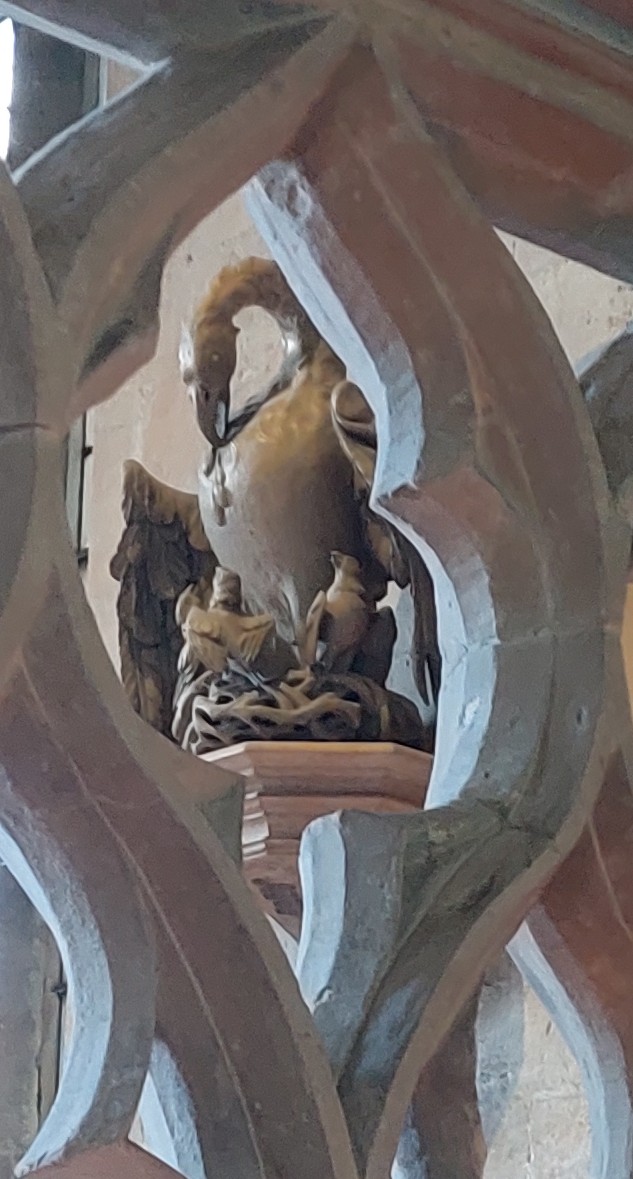
‘O soft, self-wounding Pelican’ 18th-century wooden statue, Tewkesbury Abbey

I have not sung in Tewkesbury Abbey in a long time; my only previous occasion was a day trip for a Saturday evensong with my church choir from Manchester. It was good to have an opportunity to return with Gloucester Choral Society (and Jonathan Hope conducting), whose normal base is unusable while the organ is being put back in place. We were warned that it could be cold, but of course we are used to that.

Our first half opened with Elgar’s Te Deum and Benedictus, which I’m always glad to have a chance to sing; in fact it’s not long since I did the Te Deum. This was followed by another very familiar piece to me (but not to many others in the choir), Finzi’s Lo, the Full Final Sacrifice. The main danger here was the tempo changes being rather different from those in other choirs where I’ve sung these pieces.

After the interval we sang Ian Venables’ Requiem, a piece commissioned for Gloucester Cathedral choir and sung a number of times in the area since. The composer was present, sitting a little way back in the audience. We were warned that for the most part it is slow and sustained, although not invariably so. (Maybe the faster sections just seem fast by comparison). So I found it a demanding piece to sing and it didn’t play to my strengths. The notes in themselves weren’t particularly difficult with one or two exceptions which just had to be mastered individually.

The Abbey has a gently warm acoustic and a large room for the choir to go in pre-concert, although we could have done with liberating some of the chairs which had been stacked inaccessibly in a corner. Also stable staging (not always a given), even if you had to be careful not to drop anything into the void beneath and behind your seat.

Posted in singing in concerts | Tagged , , , , , | Leave a comment

Purcell, Charles Andrews, Ives, Morley and Byrd for Lent

Meanwhile at Christ Church we sang evensong mid-March with more Purcell (Thou knowest, Lord) and the ‘faux-bordon’ canticles by one Carolus Andreas.

I am suspicious of the provenance of these last. They have been reprinted by the RSCM (starting in 1900) and others, with English words that appear to be an adaptation from the Latin, but nowhere I have seen is there given a MS or published original source or even an editor. There is no independent evidence for the composer (Andreas Carolus the theologian does not seem to have composed). The name does not look English, and yet he has conveniently written a pair of canticles for the liturgy of Anglican evensong. So like the Fayrfax faux-bordons I think these are at best an adaptation of some other piece, and quite possibly a pastiche by someone called Charles Andrews (or maybe Andrew Charles). As I’ve said of other pieces, it’s a shame we don’t know because they are a lovely simple setting, and established in the repertoire (I have sung them with several different choirs). I’m throwing down the gauntlet to anyone who can prove my conjecture wrong.

Back at Bath Abbey we sang a Eucharist for Passion Sunday, slipping in the Sanctus from Grayston Ives’ Missa Brevis, and bringing out Morley’s Nolo mortem peccatoris, which we also sang last year. I assume the Morley must have been written for use in the home rather than in services; it suddenly sounds earlier than it is around bar 45, but maybe that is because it is in only two parts at that point. Morley omitted a number of rather graphic verses from the original carol.

Our motet was Civitas sancti tui on its own, which was followed by the Communion hymn Once again, ‘Thank you for the cross, my friend’.

Posted in singing at services | Tagged , , , , , , , | Leave a comment

Purcell, Lotti and Byrd for Lent

For the second year in a row the Chamber Choir sang at the Abbey on Ash Wednesday. We opened with Purcell Remember not, Lord, used Byrd’s Four-Part mass as the setting, and during the Ashing sang Lotti’s setting of the Miserere, which I’d not come across before. It is a through-composed setting of the entire text, all very much on a level and not modulating far, so that you can stop at the end of any verse with no worse consequences than being in a different but closely related key to the one in which you started. Everyone in the congregation was ashed (very thoroughly) by about two-thirds of the way through, so that’s how much we sang.

For the second Sunday in Lent we sang choral evensong, with the Weelkes short service (like Byrd’s, I’ve sung this far less often than Gibbons Short) and a work I’d never done in a service: Byrd’s diptych of Ne irascaris and Civitas sancti tui. This last had long been on my wishlist, after I’d heard it many times on Lenten evensong broadcasts. I had sung Civitas sancti tui on its own, informally, at a Chantry Singers reunion event. So, what about that accidental in bar 96, eh? Editions and performers are split about this one, but we did it.

Posted in singing at services | Tagged , , , , , | Leave a comment

six of the best

Three of us went on a birthday outing to hear the Gesualdo Six at the Wiltshire Music Centre, giving a programme called Nachtmusik, setting texts in English, Italian and German, with less emphasis on the early repertoire that features in their recordings, and joined by the cellist Josephine Knight. Although the first half did include pieces by Dowland and Monteverdi. In between those we enjoyed a recently-composed piece, The Horse enters Troy, in which Rebecca Farthing sets lines from Aeneid II, and noted her name.

The second half focused on German Romantic compositions. A number of the pieces were arrangements and the most substantial of these was Wo?, a short text set to music arranged from the slow movement of the String Quintet D956. This movement regularly turns up when people versed in classical music list their favourite pieces; I can understand what they see in it, although it would not make my own list. We didn’t feel the arrangement really worked for us as we found ourselves missing the strings.

The only piece I’d ever sung myself was Rheinberger’s Abendlied, only unlike in Ely Cathedral we were supplied with a translation. We also heard Reger’s Nachtlied (as with anything else by Reger, I can’t remember much about this), Schubert’s partsong Die Nacht D983c and Owain Park’s own Sommernacht (some imagination required here at the back end of February).

Not all the six sang in every piece, with the ‘spare’ singers standing at one side of the stage till they were needed again. Owain Park gave engaging introductions.

It was a well attended concert with several Bathonians I knew there. Early music mavens would have liked the programme slanted more in their direction, but the rest of us were happy. They can be heard again at the Bath Festival in May.

Posted in going to concerts | Tagged , , , , , , , , , | Leave a comment

a missed chance to sing Israel in Egypt

A couple of years before I started this blog I sang in a performance of Israel in Egypt with the Brandon Hill Singers. (It was I think the last performance with orchestra that the choir ever gave.) Apart from Deborah with the Chandos Singers, it is the only oratorio by Handel, other than Messiah, that I’ve ever done.

I was invited to sing it again in a performance in Oxford this month, but sadly had to pull out because of illness. I was sorry about this, not just because I had been looking forward to revisiting this work (although it’s a big sing, and I was doing the other soprano part this time with only hazy memories of any of it!), but also because of the venue. All Saints Lime Walk, Headington isn’t one of my spiritual homes from home, but I was confirmed there (it was known as All Saints Highfield in those days). It is notable for having had for some years the longest-serving parish priest in the Church of England; he was well into his 63-year tenure when I first came across him.

Back to Israel in Egypt. Handel’s oratorios, like Haydn’s Masses, are a big gap in my performing history. I think the problem may be the popularity of Messiah with audiences, which ensures it can be put on to fill the coffers. If you’ve done that, you probably don’t want to perform another Handel oratorio in a season with maybe only three or four concerts in total. I will continue to look out for chances to at least explore Saul, Judas Maccabaeus and the rest.

Posted in repertoire, singing in concerts | Tagged , | Leave a comment

Post-Christmas carol services (2): Candlemas

On into February, there was a Candlemas carol service in church, a service which we put on in some years. There was one new piece for me: David Ogden’s setting of Angels from the realms of glory. Not an arrangement fortunately, as I find the standard tune excessively repetitive, but with a strenuous first soprano part!

Elgar featured again, in the shape of Light of the World. We also sang Whitacre’s Lux aurumque, Tallis’ O nata Lux and the Nunc from Howells’ Gloucester canticles.

Posted in singing at services | Tagged , , , , , | Leave a comment

Post-Christmas carol services (1): Epiphany

I sang in two carol services for the latter part of the Christmas season, both of which brought new repertoire with them.

First was Bath Abbey’s now annual Epiphany carol service. Among more standard pieces, we did Palestrina’s setting of Tribus Miraculis as an alternative to the more usual Marenzio, and Richard Allain’s Cana’s guest. The only previous music by Allain I’ve sung is his spiritual arrangements. Cana’s guest is a succinct piece, with some subtle symbolism worked into it.

Other music we sang included Elgar’s The Spirit of the Lord (well known to many in the choir after singing it at ordinations), No small wonder by Paul Edwards and Warlock’s Bethlehem Down.

January is a quiet month for singing, but later on I sang a couple of evensongs, the most notable music being my first encounter with Grayston Ives’ evening canticles in D.

Posted in singing at services | Tagged , , , , , , , , | Leave a comment